


What Is PETG Sheet? Physical Properties, Processing Parameters & Applications
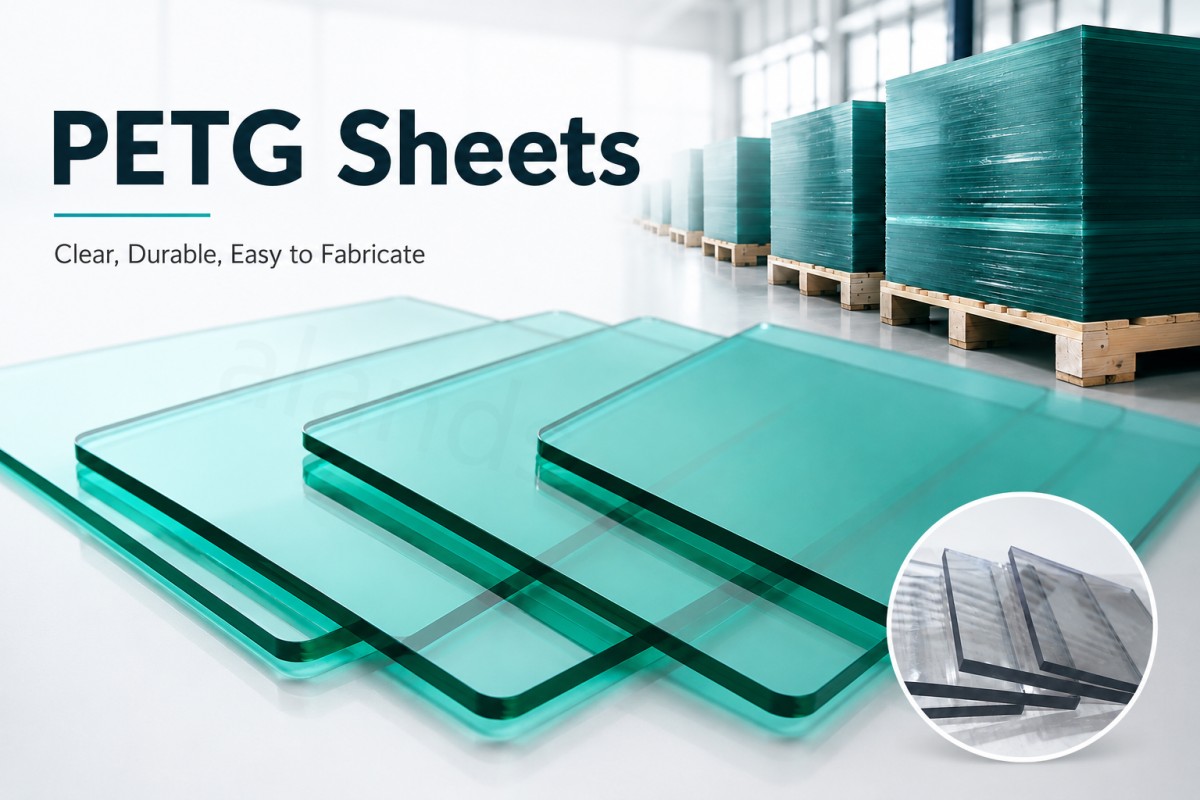
PETG is a transparent copolyester sheet that combines high clarity, good toughness, and excellent thermoforming performance. It is widely used in retail displays, thermoformed packaging, equipment covers, protective panels, medical packaging, advertising displays, and custom formed components.
For projects requiring cutting, drilling, heat bending, printing, vacuum forming, or other secondary fabrication, PETG offers good processing versatility.
What Is PETG?
PETG stands for Polyethylene Terephthalate Glycol-modified.
It is a transparent copolyester material. The glycol modification reduces the tendency of the material to crystallize during heating, making PETG suitable for heat bending, vacuum forming, and more complex three-dimensional forming.
Common PETG sheet applications include:
Typical Physical Properties of PETG
Actual PETG properties vary according to resin grade, sheet thickness, and manufacturing process. The following values can be used as typical references when selecting clear PETG sheet.
Specific projects should be based on the technical data sheet for the actual PETG grade supplied.
PETG Transparency
Clear PETG offers high light transmission, although the exact value varies between commercial grades.
Published PETG materials commonly show total light transmission of approximately 86–91%, while some specific products can achieve higher values.
The current Alands Plastic PET/PETG product page lists light transmission of approximately 93%. For bulk orders, the actual optical performance should be confirmed according to sheet thickness, surface condition, and project requirements.
For transparent displays and protective covers, buyers should consider more than light transmission alone. Other relevant quality factors include:
Mechanical Properties of PETG
PETG typically has a tensile yield strength of approximately 48–53 MPa and a flexural modulus of around 1.9–2.1 GPa.
Its relatively high elongation at break contributes to good toughness during drilling, bending, and thermoforming.
For equipment covers, display components, and formed parts, a sheet must provide sufficient rigidity while tolerating localized deformation during fabrication. PETG performs well in this type of application.
For larger finished parts, sheet thickness, unsupported span, and mounting method also have a significant effect on rigidity. Material strength alone is not sufficient for thickness selection.
Heat Resistance of PETG
PETG heat performance is commonly evaluated using heat deflection temperature, Vicat softening temperature, and glass transition temperature.
Typical clear PETG values include:
These values describe material behavior under specific test conditions and should not be interpreted as continuous service temperatures.
For PETG components installed near heat sources, lighting equipment, electrical systems, or warm industrial environments, actual load and operating temperature should be considered during material selection.
PETG Thermoforming Parameters
Thermoforming is one of the main processing advantages of PETG.
Typical forming temperatures for clear PETG sheet are approximately 135–160°C.
The final processing temperature should be adjusted according to sheet thickness, heating equipment, mold geometry, and draw depth.
When the Sheet Is Too Cold
When the Sheet Is Too Hot
For deep-draw parts, pre-stretching, plug assist, or pressure assist can be used to improve wall-thickness distribution.
Does PETG Sheet Need Pre-Drying?
Some PETG copolyester sheets can be thermoformed under normal conditions without the strict pre-drying required for resin pellet processing.
However, sheets stored for long periods in humid conditions, material with damaged packaging, or grades with specific processing requirements should be handled according to the supplier's technical recommendations.
PETG sheet thermoforming and PETG resin extrusion or injection molding are different processes and should not use the same drying conditions.
How to Calculate PETG Sheet Weight
The typical density of PETG is approximately 1.27 g/cm³.
The theoretical sheet weight can be estimated using:
For a standard 1220 × 2440 mm sheet:
Actual weight varies with sheet-size and thickness tolerances.
For bulk orders sold by weight, these calculations can be used to estimate sheets per metric ton, pallet weight, and approximate shipping quantities.
Thermal Expansion of PETG
The typical coefficient of linear thermal expansion for PETG is approximately:
Large PETG panels can change dimensions as environmental temperature changes.
Equipment covers, long transparent partitions, and large display panels should not be mounted in a completely rigid condition. Mounting holes, fasteners, and edge clearances should allow suitable movement based on panel dimensions and expected temperature variation.
Water Absorption of PETG
Typical clear PETG has a 24-hour water absorption value of approximately 0.2%.
For general retail displays, packaging, and indoor protective-cover applications, moisture absorption is usually not a major limiting factor.
For specialized processing, continuously humid environments, or applications requiring high dimensional stability, the requirements of the specific material grade should be checked.
Chemical Resistance of PETG
PETG has useful resistance to many common cleaners, oils, and dilute acids, while strong solvents can cause surface damage, stress cracking, or softening.
Chemical resistance depends on concentration, temperature, contact time, and mechanical stress in the finished part.
For equipment covers, laboratory components, medical packaging, or PETG parts installed near chemicals, compatibility with the actual substance should be confirmed before production.
PETG Sheet Fabrication
Saw Cutting and CNC Machining
PETG can be processed using saws, CNC routers, and milling equipment.
Cutting tools should remain sharp, and spindle speed and feed rate should be selected to control frictional heat.
Excessive localized heat can lead to:
Drilling
PETG can be drilled for screw mounting, assembly holes, and mechanical connections.
The sheet should be properly supported during drilling to reduce local stress around the hole.
Large holes or fastening points near sheet edges should have sufficient edge clearance.
Heat Bending
PETG can be locally heated to produce straight bends.
Typical applications include:
Vacuum Forming and Pressure Forming
PETG can be formed into trays, covers, packaging, and other three-dimensional structures.
For deep-draw components, mold depth, geometry, original sheet thickness, corner radius, and final wall-thickness distribution should all be considered.
Printing
PETG can be used with screen printing, UV printing, and other printing methods suitable for plastic surfaces.
Ink adhesion should be tested before mass production, particularly when the printed sheet will subsequently be bent or thermoformed.
Common PETG Sheet Applications
Retail Displays
Thermoformed Packaging
For food-contact applications, the specific PETG grade should have the required compliance documentation.
Industrial Guards and Equipment Covers
Medical and Pharmaceutical Packaging
PETG copolyester grades with suitable certifications can be used for medical trays, pharmaceutical packaging, and medical-device packaging.
These applications should be evaluated according to the certification of the specific material grade, sterilization method, and applicable regulatory requirements.
Advertising and Interior Applications
Can PETG Be Used Outdoors Long Term?
Standard PETG is more commonly used for indoor displays, packaging, and industrial covers.
For long-term outdoor applications, the material should have suitable UV stabilization or surface protection.
Outdoor projects should confirm:
Long-term outdoor suitability should not be determined from transparency and mechanical strength alone.
How to Choose PETG Sheet Thickness
Sheet thickness should be selected according to finished-part dimensions and processing requirements.
Thinner PETG sheets are commonly used for:
Thicker PETG sheets are more suitable for:
For thermoformed components, wall thinning during forming must also be considered.
A 3 mm starting sheet will not remain 3 mm thick throughout a deep-drawn finished part. Mold depth, geometry, and draw ratio all influence final wall thickness.
What to Confirm When Buying PETG in Bulk
Alands Plastic PET / PETG Sheet
Jinan Alands Plastic supplies PET and PETG sheet for commercial displays, packaging, interior decoration, furniture, thermoformed components, protective covers, and industrial plastic fabrication.
The current Alands PET/PETG product page lists light transmission of approximately 93% and a minimum order quantity of 1,000 kg.
For bulk quotation requests, provide:
Material type, thickness, sheet dimensions, quantity, final application, processing method, surface requirements, and required certifications.
This information allows the appropriate specification, production requirements, and quotation to be confirmed more accurately.
Frequently Asked Questions About PETG
What Is the Density of PETG?
Clear PETG typically has a density of approximately 1.27 g/cm³.
A 1220 × 2440 × 3 mm PETG sheet has a theoretical weight of approximately 11.34 kg per sheet.
What Is the Tensile Strength of PETG?
Typical clear PETG grades have a tensile yield strength of approximately 48–53 MPa.
The exact value depends on the resin grade and test standard.
What Is the Heat Deflection Temperature of PETG?
Typical PETG heat deflection temperature is approximately 60–72°C, depending on the test load.
Vicat softening temperature is typically around 83–84°C.
What Temperature Is Used to Thermoform PETG?
Clear PETG sheet is commonly formed at approximately 135–160°C.
The correct temperature should be adjusted according to sheet thickness, equipment, and mold design.
Does PETG Need to Be Dried Before Thermoforming?
Some PETG sheets can be thermoformed without pre-drying under normal processing conditions, but the requirements of the specific material grade should always be followed.
Material stored for long periods in humid conditions or specialized grades may require different handling.
Can PETG Come Into Contact with Acetone?
It is generally not recommended.
Acetone, MEK, toluene, methylene chloride, and THF can damage PETG and should be evaluated for chemical compatibility before use.
Can PETG Be Used for Food Packaging?
Yes, when a PETG grade with the appropriate food-contact compliance is selected.
Food-contact suitability depends on the specific resin and sheet grade and should not be assumed solely from the material name PETG.
Contact Us
If you have any enquiry about quotation or cooperation, please feel free to use the following enquiry form. Our sales representative will contact you within 24 hours. Thank you for your interest in our products. "*" Indicates the Fields are Mandatory
Related Posts
Request A Quote! We'll respond as soon as possible(within 12 hours)
Leave A Message